


Commercial TPP systems generally utilize single femtosecond laser beams (typically 800 nm wavelength). The use of a single femtosecond laser at a fixed wavelength presents certain limitations in photochemistry for materials and resolution capabilities. Introducing a dual-wavelength, two laser TPP system with tunable wavelengths and advanced beam shaping can significantly enhance the controllability and availability of different photo-chemistries for multi-material printing with higher resolution. The challenge then is designing a single vat TPP printing formulation which takes advantage of the dual-wavelength, two laser TPP system. Optimizing the chemistries to allow for two different polymer resin mixtures to be combined which interact independently of each other at each of the different wavelengths used is an especially challenging task.
LLNL researchers have developed a new two-photon polymerization multimaterial resin formulation consisting of two reactively distinct polymer systems. The first system consists of a liquid, optically clear, epoxy resin which undergoes polymerization via type I photoacid generator (PAG) with a photo absorber at 700 nm while the second part is an acrylic system with a customized high cross-section photoinitiator with a high absorption at 700nm and 1045nm. By combining both polymer resin formulations into a single vat and using a custom two laser, dual wavelength TPP printer system, LLNL researchers can print complex structures. They are able to print structures where the walls of the structures are printed at 700 nm, yielding a fully solid structure by activating both acrylic and epoxide chemistry, while the internal octet structure is printed using 1045nm fixed beam, which only activates the acrylic—allowing the unreacted epoxy to be washed away in the post processing procedure leaving a more porous material.
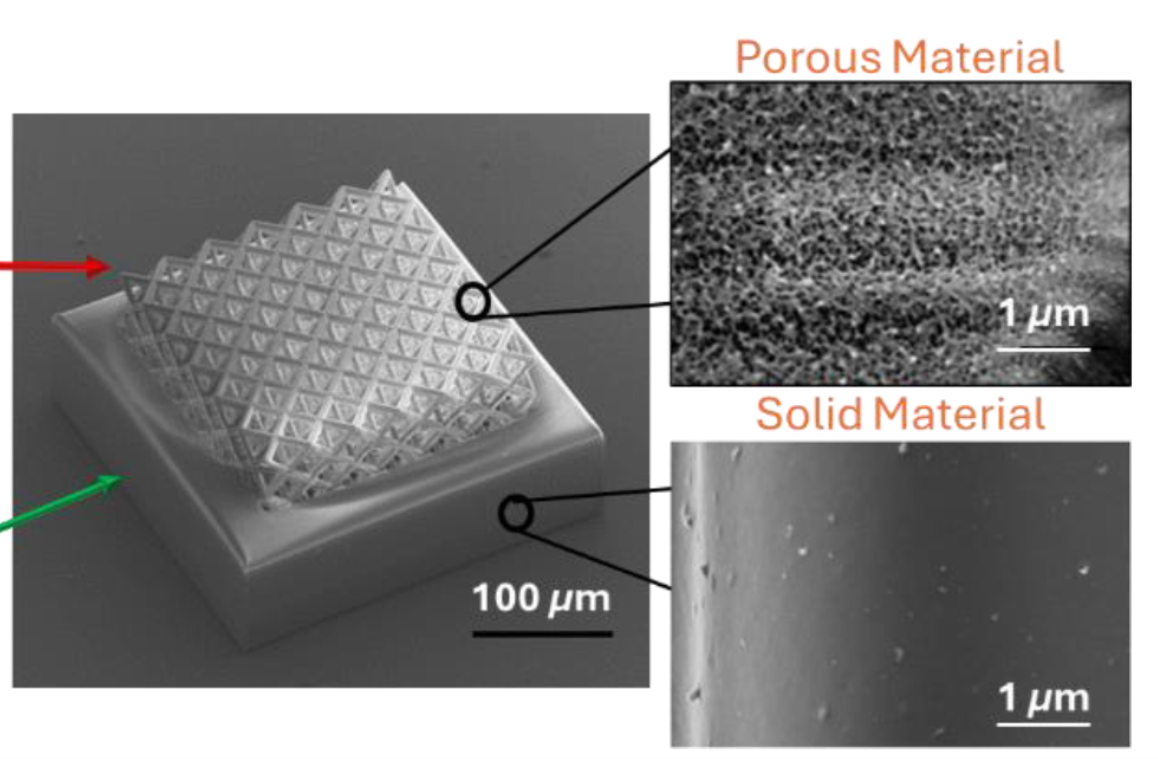
- Ability to selectively trigger disparate photochemistry enabling heterogeneous materials in a 3D structure in high resolution.
- Ability to control and tune printed materials’ optical, mechanical, and electrochemical properties for various applications. For example, refractive index, Young’s modulus, porosity, density, wettability can be spatially tuned.
- The combination of structure and material control imparts unique functionality.
- The approach simplifies the manufacturing process by finishing the heterogeneous structure in a single vat process without changing the precursor resin.
Inertial confinement fusion (ICF) printing of target fuel capsules, ability to print in a single vat resin system with density control, soft/hard material compositions, polymer/metal printing, precision medical. In essence the ability to print and tune physical properties while maintaining the high resolution of TPP printers using a single multimaterial, multi component resin formulation.
Current stage of technology development:
TRL ☐ 0-2 ☒ 3-5 ☐ 5-9
LLNL has filed for patent protection on this invention.