


Sustainable agricultural practices are intended to protect the environment, maintain and improve soil fertility while increasing production for food, feed, fuel and fiber needs. Soil sensors play a key role in managing field heterogeneity, resource expenditure, and crop selection. For industrial-scale agriculture, deployment of conventional, typically bi-metallic, sensors have major drawbacks. At the end of their lifecycle, these sensors contribute to electronic waste (e-waste). Left in the soil, sensors can leach hazardous components such as metals and microplastics. To mitigate soil contamination, these sensors have to be manually retrieved for appropriate disposal, which can be costly in time and resources.
Biodegradable sensors would negate the need for retrieval at the end of their lifecycle, but current state of the art biodegradable sensors have poor precision, short range for data collection and may not decompose readily.
In the field of precision and sustainable agriculture, there is a need for employing readily biodegradable and precise temperature soil sensors that enables large-scale data collection, which would help farmers improve their production efficiency, productivity, and profitability.
LLNL researchers developed and field-tested a biodegradable soil temperature sensor device that can be used in industry-scale agriculture. At the end of their lifecycle, these sensors can be left in situ. To measure temperature, the sensor utilizes a bimaterial helix, which rotates in response to temperature changes. The cellulosic-based helix is contained within a biodegradable plastic such as polylactic acid (PLA) cylindrical casing with a large readout dial; altogether the device is 99% biodegradable.
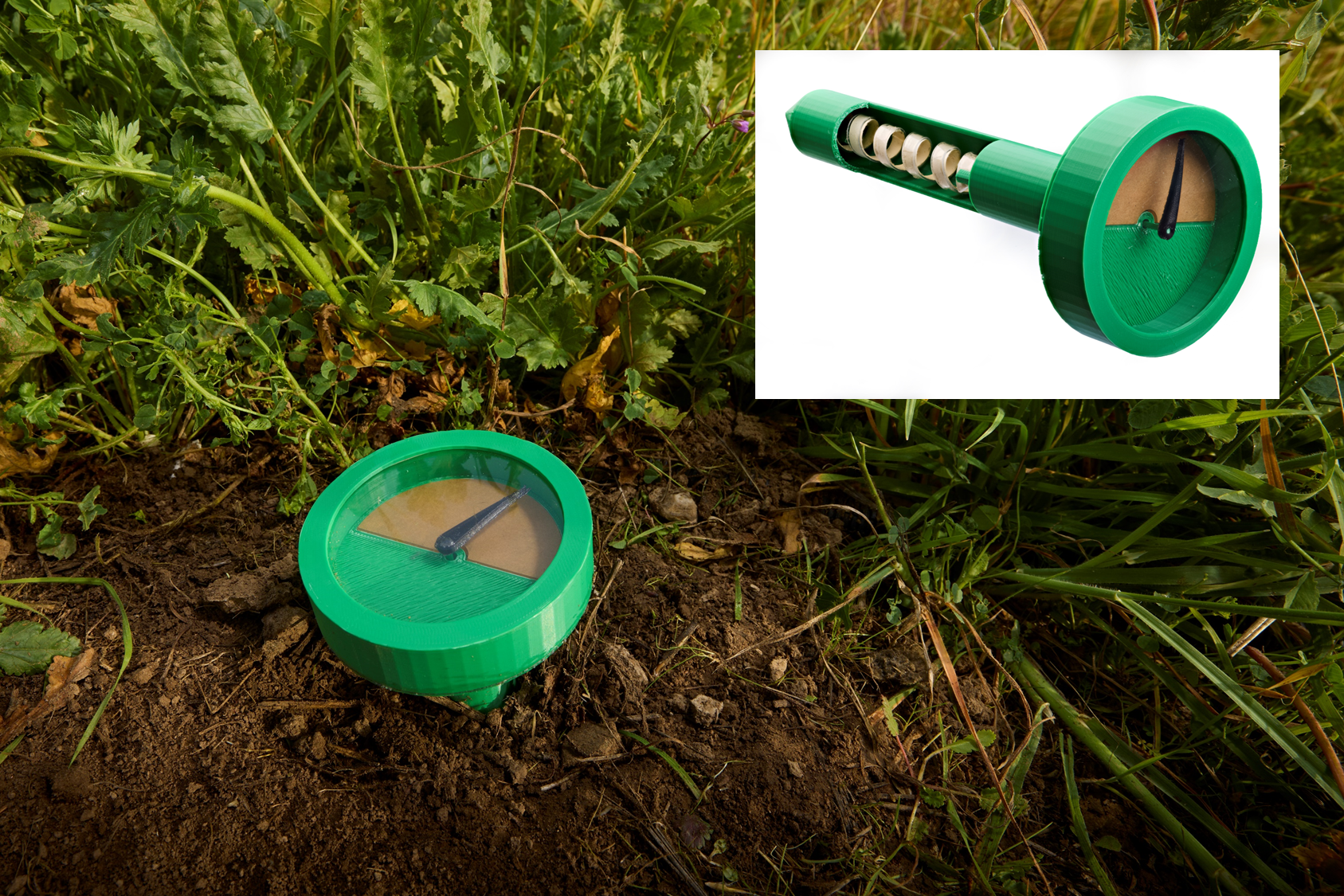
- Field-tested
- Biodegradable sensing mechanism and housing (99% biodegradable)
- Removes need for manual retrieval at end of lifecycle
- High precision while eliminating e-waste that is generated if conventional soil temperature sensors are used
- Small environmental footprint – can be operated without batteries and wiring
- Easy to view readout dial for data collection (e.g., via aerial drone imaging)
sustainable agriculture and composting, particularly on an industrial scale
Current stage of technology development:
TRL ☐ 0-2 ☐ 3-5 ☒ 5-9
LLNL has filed for patent protection on this invention.